
Welding Automation Planning Guide for 2026: Your Complete Framework

Executive summary
Planning welding automation for 2026 requires evaluating three critical areas: your current capacity constraints, workforce stability risks, and production scalability goals. This framework helps fabrication shop owners make confident automation decisions by identifying true bottlenecks, calculating hidden costs, and building realistic implementation timelines. Most successful deployments start with understanding where automation creates the biggest impact, not just where it seems most obvious.
Key takeaways
- Workforce shortage is accelerating - The U.S. will need 320,500 new welding professionals by 2029, with 80,000 positions to fill annually between 2025 and 2029
- Modern cobots deploy in hours, not months - Fabrication shops can have systems welding the same day they arrive, compared to months-long traditional robot installations and programming downtime
- ROI timelines are shorter than expected - One marine fabricator paid for their entire cobot system with a single Coast Guard order; many shops see full payback within 12 months
- Programming takes minutes, not hours - Industrial Manufacturing Services programs new parts in 4 minutes versus 1 hour with traditional robots
Why 2026 planning starts now
Most fabrication shops start thinking about automation when they're already overwhelmed. You're turning down work, running mandatory overtime, or watching skilled welders consider other opportunities.
The problem with waiting until you're desperate: you make decisions based on urgency rather than strategy. You skip the planning that determines whether automation actually solves your problem or just creates an expensive new bottleneck.
Here's what forward-thinking shops are doing differently: they're evaluating automation now—while they still have time to get it right. They're asking hard questions about their operations. They're building realistic timelines that account for training, process changes, and team buy-in.
This doesn't mean you need to buy equipment today. It means understanding your operation well enough to make a confident decision when the time comes.
The three questions that determine automation success
Question 1: Is welding actually your bottleneck?
Walk your production floor right now. Where are parts piling up?
Common scenario:
- Laser and press brake running smoothly
- Bent parts stacked everywhere
- Welding stations can't keep up
That looks like a welding bottleneck, right?
Maybe. But dig deeper.
Ask yourself:
- Are your welders actually welding, or spending time on fit-up, material handling, or rework?
- What's your actual arc-on time versus total labor hours?
- If you doubled welding capacity tomorrow, where would the next bottleneck appear?
Real example from Industrial Manufacturing Services:
Matt Blowers, Manufacturing Engineer at IMS in Lancaster, South Carolina, thought welding was their constraint. When they analyzed their process, they found welders were spending significant time on setup and changeover instead of actual welding.
After implementing Hirebotics Cobot Welder, IMS shifted their simplest, most repetitive welds to automation. This freed experienced welders to focus on complex assemblies where their expertise creates the most value. Their real bottleneck wasn't welding capacity—it was welder utilization.
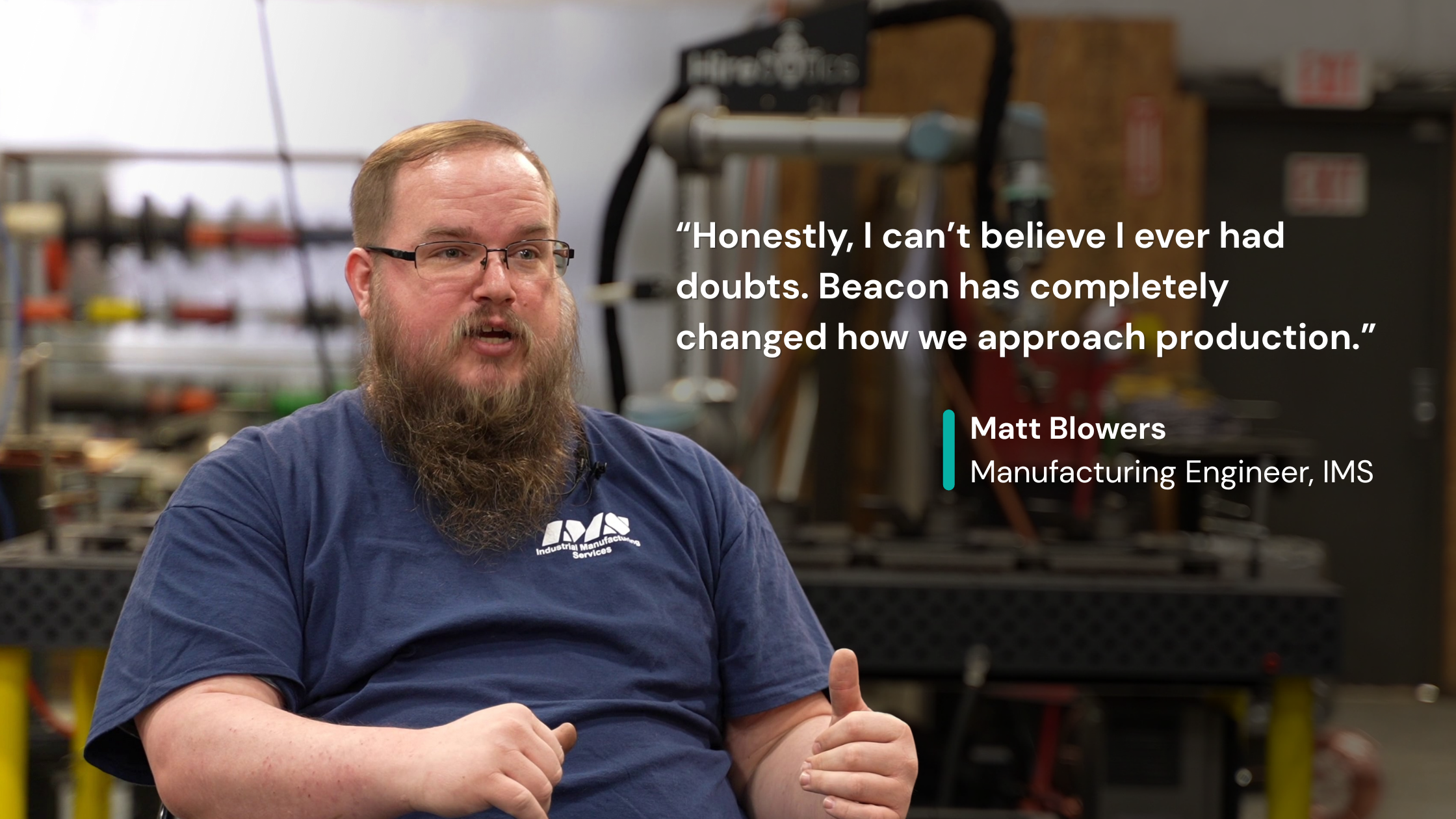
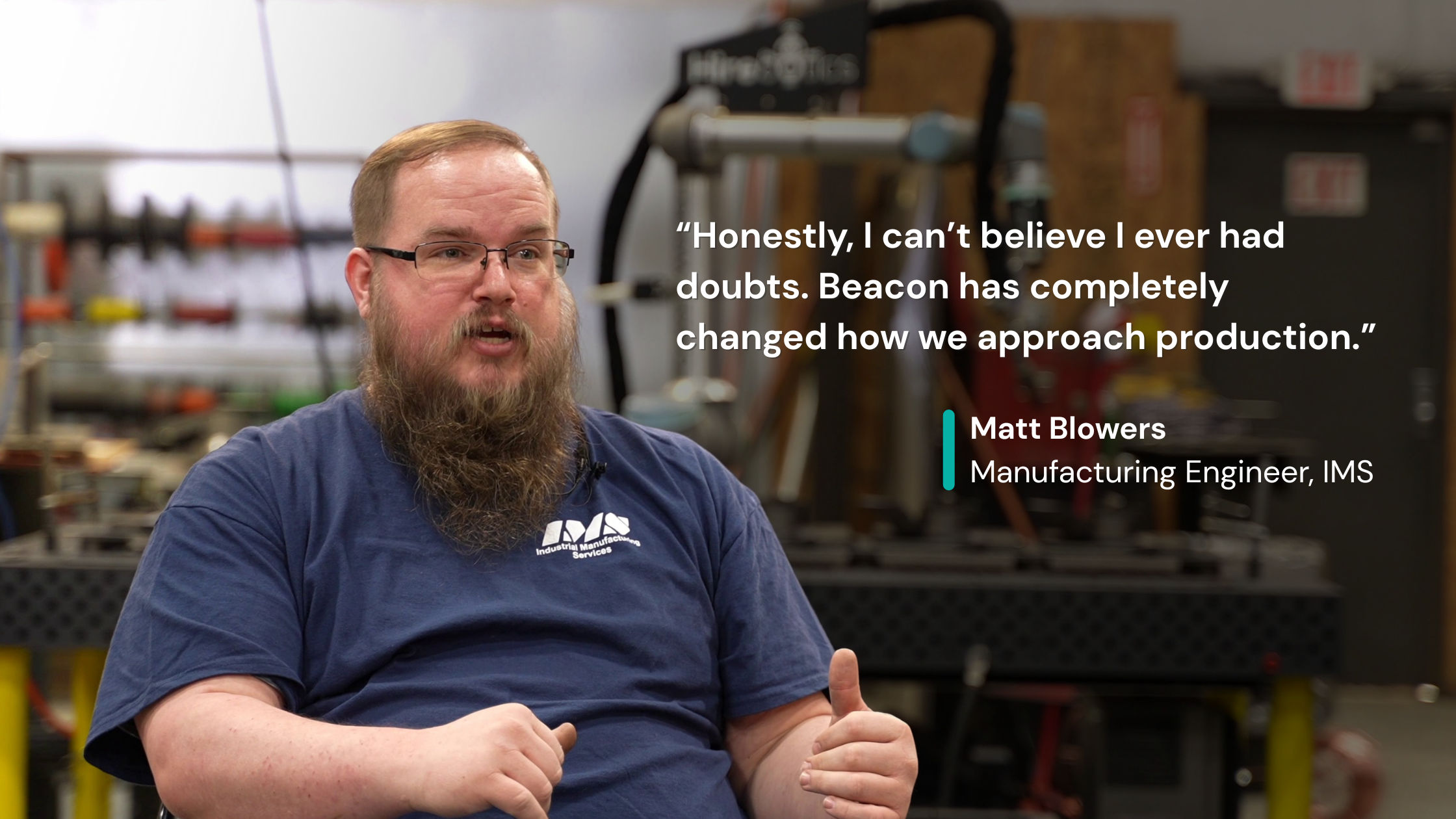
"Programming a traditional robot might take an hour. With Beacon, I've done it in four minutes," Blowers said.
How to assess your true bottleneck:
Follow one part from raw material to shipping. Time each step:
- Raw material to cut/punch
- Forming/bending operations
- Waiting time before welding (this is the revealing one)
- Actual welding time
- Post-weld operations (grinding, inspection)
- Final assembly and finishing
You may discover that a significant portion of your "welding problem" is actually material flow, scheduling, or upstream consistency issues.
Decision framework:
| If Your Analysis Shows | Then Consider |
|---|---|
| Welding is clear bottleneck + parts flow smoothly | Automation is likely a good fit |
| Welding is slow but parts wait upstream | Fix material flow first, then automate |
| Welding keeps up but quality varies | Automation for consistency, not just speed |
| Multiple bottlenecks across the shop | Start with most repetitive welding work, measure impact |
Question 2: What's your real cost of the status quo?
The U.S. welding industry faces a critical shortage: 320,500 new professionals needed by 2029, with 80,000 positions to fill annually between 2025 and 2029, according to recent workforce data.
For your shop, this means:
- Harder to find skilled welders
- Higher wages to attract and retain talent
- Increased risk of production disruptions
- More pressure to run overtime
Hidden costs most shops miss:
Beyond the obvious recruitment and training expenses, consider:
Opportunity costs of capacity constraints:
- Work you turn down because you can't commit to delivery dates
- Premium pricing you can't charge because you're not the reliable supplier
- Growth opportunities you pass on because you can't scale
Overtime and burnout costs:
Mandatory overtime feels like a solution, but the math often doesn't work. Here's an example calculation (your actual numbers may vary):
- Base rate: $30/hour
- Overtime rate: $45/hour (1.5x)
- Efficiency at hour 10 of a shift: approximately 65-70%
- Effective cost per productive hour: $63-$69
Compare that to automation running consistent quality during off-hours:
- System cost: Starting at $105,000
- Consistent output, no fatigue degradation
- No benefits, no overtime premium
Real-world ROI example:
DeAngelo Marine Exhaust, a New Jersey-based fabricator, needed to weld 200 inches per unit for a Coast Guard order. Manually with TIG welding, it would take 100 minutes per piece. With their Hirebotics Cobot Welder running MIG? 10 minutes.
That single project covered the full cost of the system.
"From 2 inches per minute with TIG to 20 inches per minute with the Cobot Welder," the team reported. "Weld speed increased 10X."
For detailed ROI calculations specific to your operation, explore our C-Suite guide to cobot ROI.
Question 3: What does success actually look like?
This is where most planning falls apart.
Shop owners say: "We need automation."
We ask: "What does success look like six months after deployment?"
Without clear success criteria, you can't evaluate options, build realistic timelines, or know if your implementation actually worked.
Define success across three dimensions:
1. Operational metrics (what gets measured)
Clear, specific targets:
- Increase welding output from 25 to 100 units per day (like Advanta Southeast achieved)
- Reduce setup/changeover time from 1 hour to 4 minutes (like IMS accomplished)
- Achieve time savings up to 90% on repetitive welds (like Vortex Companies documented)
- Maintain consistent quality across all shifts
Not vague goals like "improve efficiency" or "make things easier."
2. Business outcomes (what matters to the company)
Connect operational changes to business impact:
- Take on 20% more work without adding headcount
- Reduce quoted lead times from 6 weeks to 4 weeks
- Win contracts you couldn't have taken on before
- Clear backlogs that have been building for months
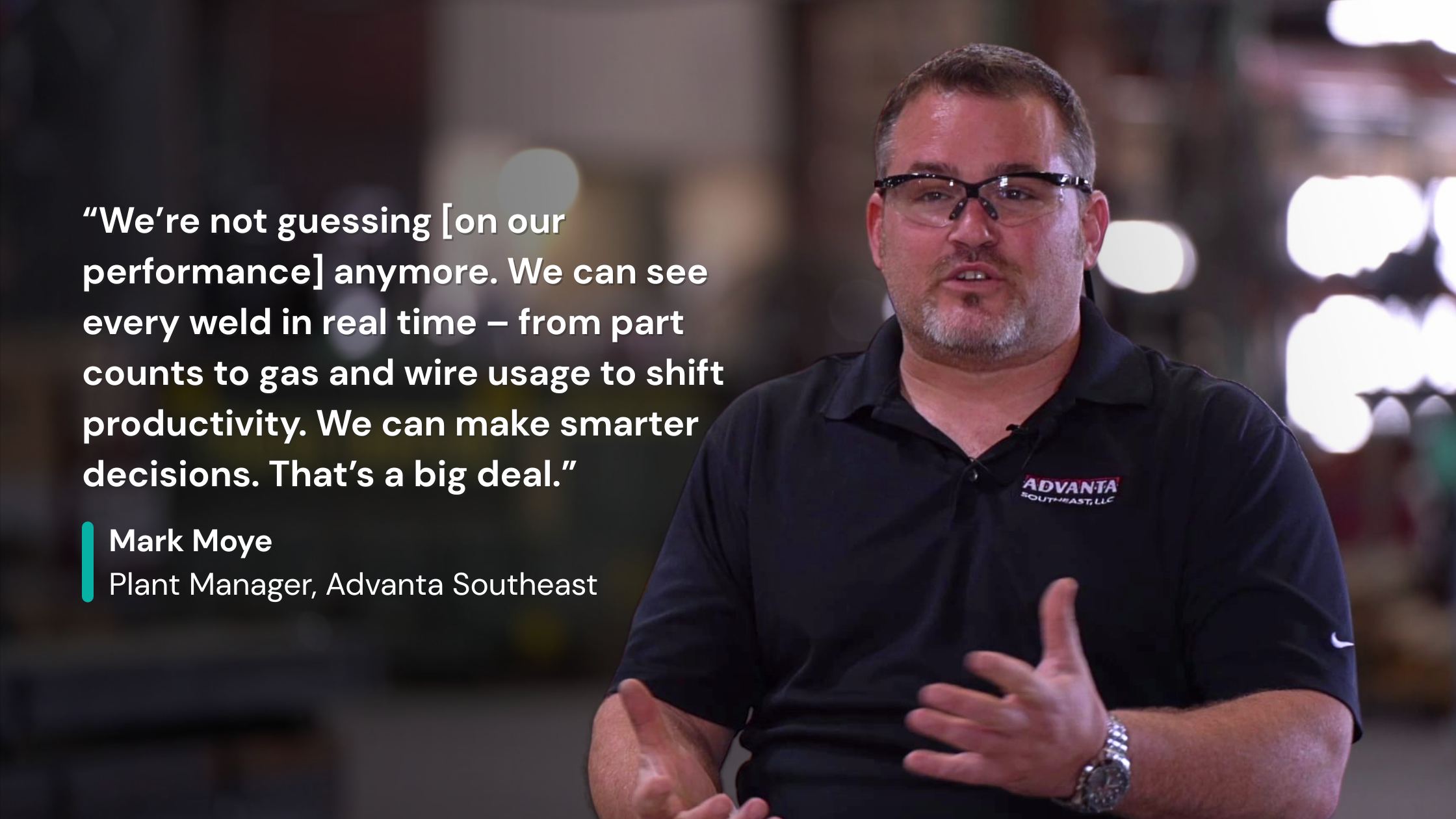
Advanta Southeast provides a strong example: With such a strong ROI, Advanta added three more cobot welders to the South Carolina plant—and expanded the solution to their Michigan facility, too. Just a few months in, the added capacity helped them win contracts they wouldn't have been able to take on before—including large-scale fabrication for an electric vehicle manufacturer.
3. Team impact (what changes for people)
Often overlooked but critical for success:
- Experienced welders focus on complex work they're proud of
- Reduce repetitive strain from high-volume simple welds
- New welders can be productive faster with automation handling precision work
- Eliminate firefighting and last-minute schedule changes
Your success framework template:
90-Day Goals:
Operational: _________________________________
Business: ___________________________________
Team: _______________________________________

6-Month Goals:
Operational: _________________________________
Business: ___________________________________
Team: _______________________________________

12-Month Goals:
Operational: _________________________________
Business: ___________________________________
Team: _______________________________________
Implementation timeline: What to expect
Understanding realistic timelines prevents disappointment and helps you plan properly.
Traditional robotic welding integration
Typical timeline: Several months from decision to production
Traditional robotic welding systems typically involve:
- Vendor selection and specification
- Custom system design and engineering
- Fabrication and programming by specialists
- Installation and integration
- Training and debugging
- Ramp to full production
Challenges:
- Long lead times mean market conditions change during implementation
- Custom integration means higher upfront costs ($150K-$500K+, according to industry sources)
- Specialist programming required for changes
- Difficult to validate approach until late in the process
Collaborative robot (cobot) deployment
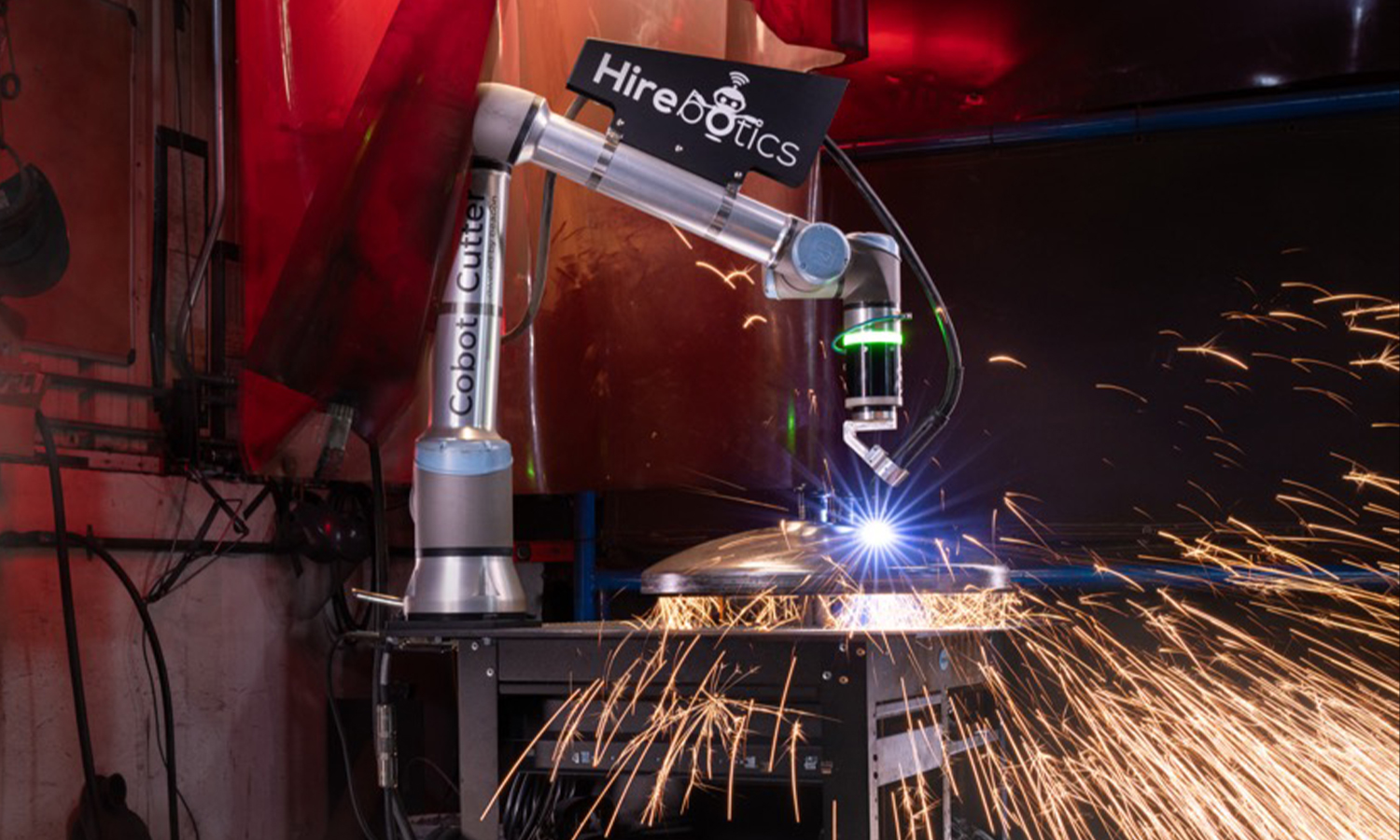
Typical timeline: Same day to production
Delivery day: System arrives and team begins setup – Unbox, position equipment, connect power
First 30 minutes: Initial app-based training and first test welds
30 minutes. Seriously.
Don't take our word for it – Matt Blowers told us, "We had welders using it confidently in about 30 minutes. It's intuitive. You don't need a programming degree—or even welding experience—to get going."
Within days, the team was running production jobs. Within weeks, they had expanded to multiple part families.
Advantages:
- Fast validation—know quickly if approach works
- Our visit the
- Lower initial investment (starting at $105,000)
- Your welders can easily make weld setting and placement changes with a click, through the Beacon app
Common planning mistakes (and how to avoid them)
Mistake #1: Starting with technology instead of problems
What it looks like:
"We need a welding robot. Which one should we buy?"
Why it fails:
You're solving for "get a robot" instead of "solve our capacity/quality/consistency problem."
Better approach:
Define the business problem first. Then evaluate if automation solves it, and which approach fits best.
Mistake #2: Underestimating change management
What it looks like:
"We'll buy the robot, IT will set it up, welders will run it."
Why it fails:
Automation changes workflows, responsibilities, and sometimes people's sense of identity around their craft.
Better approach:
Involve your welding team from day one. Frame automation as making them more capable, not replacing them. Plan for process changes, not just equipment installation.
Warren Earl, President of IMS, noted: "Ten or fifteen years ago, finding skilled welders was easy. Today? Not so much." The shops succeeding with automation are the ones positioning it as a solution that empowers their existing team rather than replacing them.
Mistake #3: Choosing based on price alone
What it looks like:
"Vendor A is $20K cheaper than Vendor B."
Why it fails:
Ignores total cost of ownership—training time, support quality, programming complexity, changeover speed, and expansion limitations.
Better approach:
Evaluate based on total cost over 3-5 years, including your team's time to program changes, support responsiveness, and ease of scaling to additional applications.
Beacon creates a unified environment across your entire production line. Plasma cutting, welding, and painting—all run in the same intuitive application. Your teams get one familiar ecosystem, so they can move confidently between stations with faster training, steadier quality, and fewer errors.
Mistake #4: Not planning for success
What it looks like:
"Let's just get started and see what happens."
Why it fails:
Without defined success metrics, you can't evaluate vendors, justify investment, or know if it's working.
Better approach:
Use the success framework template above. Be specific. Make it measurable.
Building your 2026 automation plan
Here's a practical framework for planning automation implementation:
Phase 1: Assessment (Q4 2025 - Q1 2026)
Goal: Understand your operation and build business case
Actions:
- Complete the three-question framework above
- Identify top 3-5 most repetitive weld applications
- Document current cycle times and quality metrics
- Engage welding team in evaluation process
Outputs:
- Quantified business case with realistic ROI
- List of initial target applications ranked by impact
- Team buy-in and champion identification
Timeline: 4-6 weeks
Phase 2: Vendor evaluation (Q1 2026)
Goal: Choose the right automation partner (not just equipment)
Focus areas:
- Implementation approach and timeline
- Training and support model
- Flexibility for your high-mix environment
- Total cost of ownership
- Cultural fit with your team
Timeline: 3-6 weeks
Phase 3: Pilot deployment (Q1-Q2 2026)
Goal: Prove the concept with minimal risk
Approach:
- Start with one weld cell
- Focus on highest-volume, most repetitive work
- Measure everything—cycle times, quality, changeover time
- Document lessons learned
- Refine process before scaling
Success criteria:
- Hit 90-day operational goals defined earlier
- Team competent and confident with system
- Clear path to expanding to additional applications
Timeline: 1-3 months
Phase 4: Scale (Q2-Q4 2026)
Goal: Expand to additional applications with confidence
Approach:
- Add second and third part families based on initial learnings
- Train additional operators
- Optimize workflow and material handling
- Measure business impact (revenue growth, lead time reduction)
Timeline: 6-9 months
Industry-specific considerations
Data center fabrication
The data center construction boom creates unique opportunities and challenges. Fabricators supporting this market need:
- Fast turnaround on high-volume orders
- Consistent quality for modular components
- Scalability to meet project surges
- Documentation and traceability
For detailed guidance on automation in data center fabrication, download our data center fabrication playbook or explore automation solutions for data center work.
High-mix, low-volume production
If you're running hundreds of different part numbers in small batches:
- Setup time matters more than pure weld speed
- Flexibility to handle variation is critical
- Programming simplicity determines actual utilization
- Changeover speed directly impacts profitability
Justin Payne, Manufacturing Engineer at IMS, highlighted this advantage: "If you're running multiple cobots, you can transfer programs with copy-paste. It's just faster."
Advanced capabilities to consider
As you evaluate automation systems, consider future needs:
Through Arc Seam Tracking
For parts with variable gaps or inconsistent fit-up, seam tracking automatically adjusts torch position in real-time. This is particularly valuable for:
- Fabrications with variable joint gaps
- Parts with height variations
- Applications requiring consistent penetration despite part variability
Hirebotics' Through Arc Seam Tracking (TAST) provides lateral and vertical correction with configurable sensitivity, available as a $100/month add-on subscription per robot.
Multipass welding
For thicker materials requiring multiple weld passes, multipass capabilities eliminate manual repositioning and ensure consistent layer buildup.
Remote monitoring and support
Cloud-based platforms like Beacon enable:
- Remote program adjustments from your phone
- Real-time troubleshooting without shop floor visits
- Performance analytics across multiple cells
- Centralized program management
Next steps: From planning to action
You don't need to have all the answers today. But you do need to start asking the right questions.
This week:
- Walk your production floor with fresh eyes. Where are parts actually waiting?
- Identify your three most repetitive weld applications
- Document current cycle times for those applications
This month:
- Complete the three-question framework with your team
- Define what success looks like using the template above
- Engage your welding team in the conversation
This quarter:
- Evaluate automation approaches and vendors
- Build consensus with your team on pilot application
- Develop detailed ROI projection using our C-Suite guide
The real question isn't "should we automate?"
It's "how do we grow our business while maintaining quality and culture?"
For some shops, that means automation. For others, it means fixing upstream processes first. For many, it's a combination.
The shops that succeed in 2026 are the ones planning strategically now—while they still have time to get it right.
With 80,000 welding positions to fill annually and competition increasing, the question isn't whether you'll need to adapt, but whether you'll adapt proactively or reactively.
Schedule a consultation
Have questions about your specific situation? We talk to fabrication shop owners every day who are navigating these same decisions.
No pressure, no sales pitch—just honest conversation about what might work for your operation.
Schedule a 30-minute consultation
Related resources:
- C-Suite guide to cobot ROI - Financial analysis framework for presenting automation investment
- Data center fabrication automation - Industry-specific automation strategies
- Case studies - Real results from fabrication shops using Hirebotics cobots