
From Stiffeners to Bulkheads: One Cobot, Multiple Stations

Post by
Corey Good
January 27, 2026
January 27, 2026
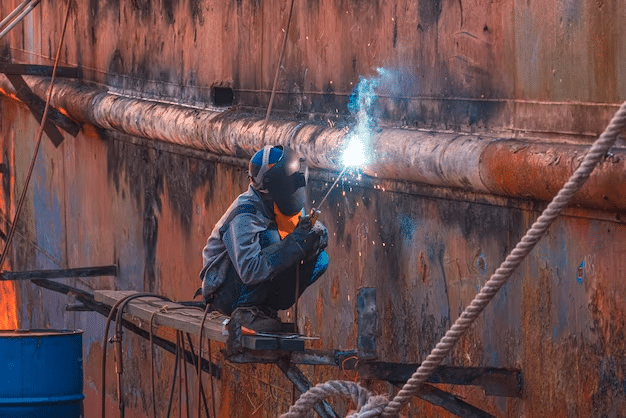
Most welding robots do one thing, in one spot—forever.
Shipyards don’t work that way.
On Monday, you’re welding stiffeners. Tuesday brings bulkhead assemblies. Wednesday shifts to frame work. Thursday? A rush job that wasn’t even on the schedule.
The work moves. Priorities shift. That’s ship fabrication.
This is exactly why single‑purpose robotic welding cells fail in shipyards. Fixed automation can’t follow the work.
Mobile, collaborative welding can.
Why fixed welding robots sit idle in shipyards
Traditional robotic welding cells are designed for assembly‑line production. They assume:
-
One application
-
One fixture
-
One permanent location
That model works in automotive plants. It breaks down in shipbuilding.
When a fixed robot is tied to stiffener welding and the work moves to bulkheads, the robot sits idle—while welders scramble three bays over. You’re left with expensive automation that only delivers value part of the time.
Shipyards need welding automation that moves with the work, not equipment that forces the work to come to it.
How one mobile cobot handles multiple welding jobs
Here’s what mobile collaborative welding looks like in practice using magnetic mounting:
Monday morning: Stiffener welding
Mount the cobot to your deck panel or stiffener fixture using a magnetic base. Your welder teaches the weld path in about 20 minutes. The cobot runs consistent fillet welds all morning while the welder focuses on higher‑skill work.
Tuesday: Bulkhead assemblies
Stiffeners are complete. Release the magnetic base, move the cobot to bay two, and re‑mount it to the bulkhead fixture. Setup takes about 10 minutes. Teach the new path and start welding structural joints.
Wednesday: Frame fabrication
Different bay. Different application. Same cobot. No facility changes, no reinstallation.
Thursday: Rush job appears
Your welder jumps on the urgent work. The cobot keeps running production welds. Capacity stays online.
One cobot. Multiple stations. Maximum utilization.
The time question: Is moving the cobot worth it?
This is the most common concern we hear.
Typical redeployment time:
-
Move and re‑mount: 5–10 minutes
-
Run or teach a new weld path: 0–30 minutes
-
Total: 5–40 minutes
You trade less than an hour of setup for hours—or days—of automated welding capacity. Compared to a fixed robot sitting idle, the math isn’t close.
Applications that work best for mobile welding cobots
Stiffener welding
Highly repetitive by nature. Program once and run hundreds of identical welds. Beacon’s Through‑Arc Seam Tracking automatically adjusts for fit‑up variation without stopping production.
Bulkhead structural welds
Thick plate often requires multiple passes. Beacon’s Multipass functionality breaks heavy welds into controlled passes with verification between each one—ideal for structural shipbuilding work.
Frame assemblies
Joint geometry may vary slightly, but the welding process stays consistent. Teach the pattern once and apply it across multiple frames and fixtures.
Subassemblies
If you’re producing parts in quantity, a cobot can handle repetitive welding while your welders focus on complex joints and critical tasks.
What your welders do instead
Mobile automation doesn’t replace welders—it multiplies their impact.
Less repetitive work:
Cobots handle stiffeners, structural welds, and production subassemblies.
More skilled work:
Welders focus on complex joints, difficult positions, repairs, training, and specialized fabrication.
Programming and oversight:
Welders teach new applications as work changes, adjust parameters, and maintain quality control.
Urgent work coverage:
When rush jobs appear, welders respond immediately while the cobot continues production.
DeAngelo Marine: One cobot, constantly moving
DeAngelo Marine in Gloucester, Massachusetts builds fishing vessels, government ships, and handles repair work—all on the same shop floor. No two jobs are exactly alike, and schedules change constantly.
Their cobot moves between stiffener welding, structural fabrication, different fixtures, and different bays as needed.
“We were able to move that welder to a different project that was time‑sensitive. The robot picked up right where he left off and completed the job.”
The cobot doesn’t shift priorities or leave for urgent work. It keeps running while your team handles what only humans can.
Programs transfer—They don’t disappear
Share across multiple devices and cobots:
Teach a path on one cobot and access from all of the cobots across your shop floor, from any device.
Cloud‑stored programs:
Beacon stores weld programs in the cloud. Run the same application weeks later? Load it and go.
Continuous improvement:
As parameters improve, those gains stay in the system. Programs developed on one cobot transfer to the next.
How shipyards start using mobile cobots
1. Identify the bottleneck
Find the repetitive welding that’s consuming the most welder time.
2. Prove the value
Deploy one cobot on high‑volume work and generate immediate capacity.
3. Expand deliberately
Once the first application runs smoothly, redeploy the same cobot to the next opportunity.
4. Add capacity when ready
High utilization across multiple applications justifies adding a second cobot—without adding infrastructure.
When schedules change—and they always do
Shipbuilding schedules are never static. Materials arrive late. Customers shift priorities. Rush jobs appear.
Fixed robots can’t adapt. They either run their single application or sit idle.
Mobile collaborative welding adapts naturally. Move the cobot to wherever capacity is needed most and keep production moving.
Teaching takes minutes, not weeks
Welders don’t need to become robot programmers.
Beacon’s teaching mode mirrors how welders already work:
-
Guide the cobot through the weld path
-
Set parameters like voltage, wire speed, and travel speed
-
Run a test weld and inspect quality
-
Adjust and repeat
Most welders are programming production welds within minutes of first using the system.
“Twenty minutes after setup, I was welding like I’d been running robots my whole life.”
– Justin Montes
CEO, DeAngelo Marine Exhaust
The bottom line
Ship fabrication doesn’t happen in one place, on one fixture, for one job.
That’s why welding automation needs to be as flexible as the work itself.
One mobile cobot moving between stiffener fixtures, bulkhead stations, and frame assemblies delivers more real value than multiple fixed robots that sit idle whenever priorities shift.
Your work moves. Your automation should too.
Want to identify which welding applications in your facility are the best fit for mobile collaborative automation? Let’s walk through your production and find the highest‑value opportunities.