
Cobot painting vs. manual spraying: What to know

Post by
Corey Good
March 3, 2026
March 3, 2026
You welded it. You prepped it. You inspected every joint. Then you loaded it onto a truck, sent it across town to someone else's shop, and hoped it came back right.
That's the reality for thousands of fabrication shops that outsource their coating work. And most of the time, it's fine. The parts come back. The finish is acceptable. The invoice shows up a week or two later.
But "fine" has a cost — and if you've been outsourcing long enough, you already know what it looks like. It's the job that sat at the coater for nine days when you quoted your customer five. It's the scratched finish from transit that forced a redo. It's the batch that came back with uneven coverage and you had to decide whether to ship it or eat the delay. It's padding an extra week into every delivery estimate just because you can't control what happens after the parts leave your dock.
None of that shows up as a single line item. But it shows up everywhere — in your margins, your lead times, and your customer's patience.
That's why more shops are looking at bringing painting in-house. And thanks to collaborative robot painting, the math has changed on what that actually requires.
The hidden P&L of outsourced coating
Most shop owners know what they pay per batch to their coating vendor. Fewer have added up what outsourcing actually costs when you account for everything around it.
Start with the direct spend. A shop sending out five batches a week at $250 per batch is writing checks for over $65,000 a year — just in coating fees. Add freight, packaging, and rush charges for the jobs that can't wait the standard 5–7 day turnaround, and the real number climbs fast.
Then there's the cost you can't easily invoice: lost time. Every day a part sits at an outside coater is a day it's not moving through your shop toward shipment. That idle time forces you to carry more work-in-process inventory, build longer lead times into your quotes, and sometimes turn down jobs because you can't guarantee the finish date. One industry source noted that shops bringing coating in-house have seen cycle times drop by as much as 30% simply by eliminating the transport-and-wait loop.
Quality risk adds another layer. Parts get scratched, dinged, or contaminated in transit — before they're even coated. And once they're at the vendor, you're trusting someone else's process controls, someone else's operators, and someone else's definition of "good enough." Irregular film thickness, adhesion issues, color mismatch, and surface defects are all common complaints from shops that outsource. Every rejected part means rework, re-shipping, and another delay your customer feels.
The hardest cost to quantify is the one that matters most: you don't own the finish. You built the part, your name is on it, and the final step — the thing the customer actually sees and touches first — is out of your hands.
Why most shops never brought coating in-house
If the outsourcing math is that bad, why doesn't every shop just set up their own paint line?
Because traditionally, the cure was almost as painful as the disease. A full in-house powder coating system — washer, booth, oven, conveyor — starts around $200,000 for a basic batch setup and can run well past $750,000 for an automated conveyorized line. That's before you account for the building modifications, utility connections, exhaust infrastructure, and the floor space you'll never get back.
Then there's the expertise problem. A good painting or coating operation isn't just equipment — it's chemistry, process knowledge, and skilled operators. As one powder coating consultant put it, you can go to school to learn welding, but finding people who deeply understand coating application and process control is a different challenge entirely. Shops that invest in the equipment but underestimate the knowledge required often end up with in-house quality that's no better than what they were getting from their vendor.
For most small and mid-size fabricators, the calculation has always landed in the same place: outsourcing is painful, but the alternative is a massive capital commitment for a capability that isn't your core business.
That equation held for a long time. It's not holding anymore.
What changed: Painting automation without the paint line
The shift happening in painting automation right now isn't about bigger, faster, or more expensive robotic painting systems. It's about making automated painting accessible to operations that were never candidates for traditional systems.
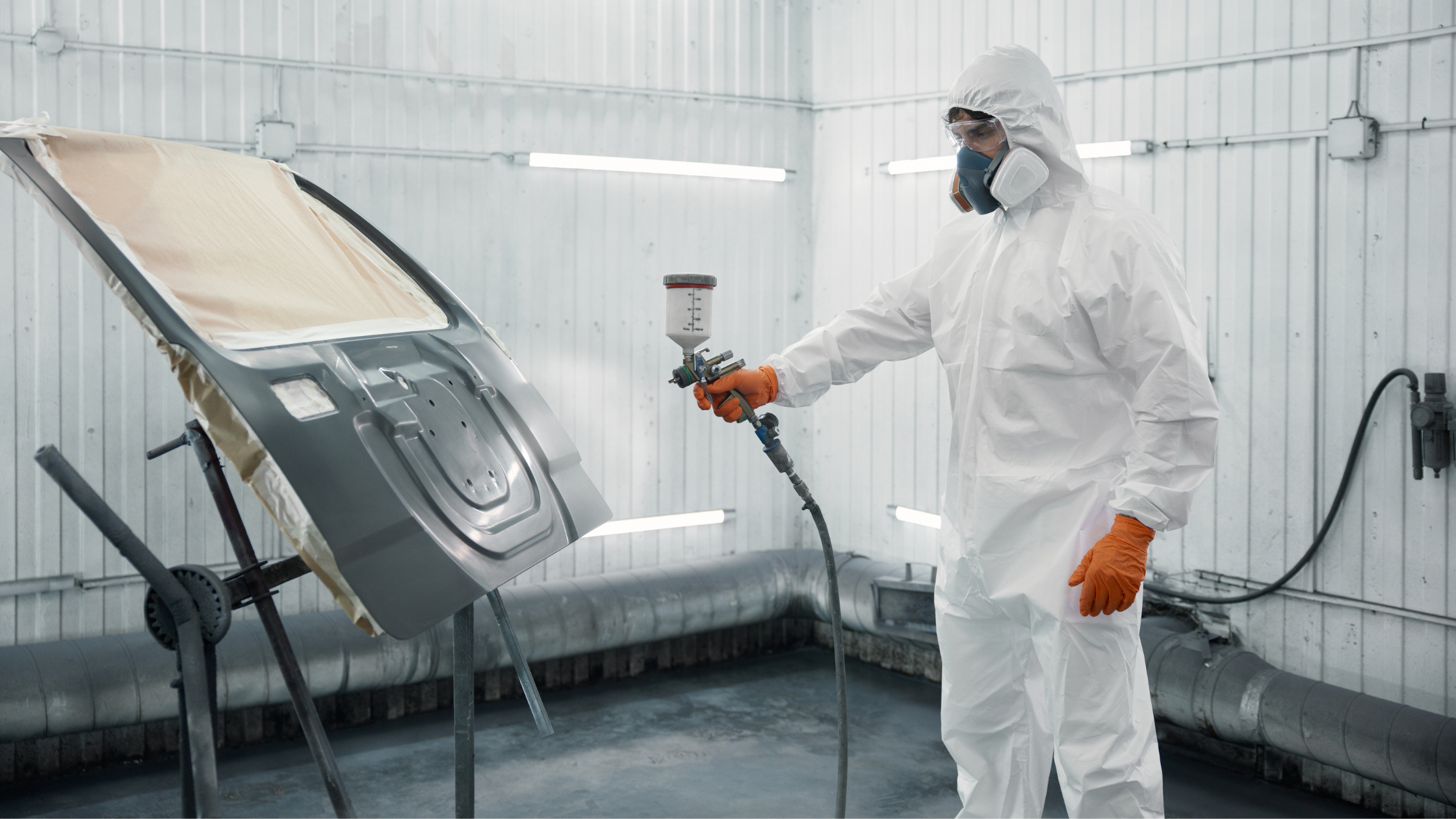
A collaborative painting robot — a cobot painter — doesn't require a dedicated paint cell, a conveyor, or a robotics engineer. It's a portable, lightweight system that rolls into your existing spray environment on a stand. You teach it a spray path using a tablet — no code, no offline programming, no integrator visit. Your operator guides the robot through the motion once, adjusts the parameters on screen, and the cobot repeats that path with the same speed, distance, and angle every cycle.
The FANUC CRX-10iA/L Paint — the first explosion-proof collaborative paint robot certified for global sale — is what makes this practical. It weighs 45 kg, fits inside a manual paint booth, and handles powder coating, liquid paint, gel coat, and fiberglass applications. It's rated for the hazardous environments where coating actually happens, which is the technical hurdle that kept cobots out of painting for years.
But the real story isn't the robot. It's what it means for a fab shop's business model.
Instead of a $200,000+ paint line that takes months to install and permanently occupies a chunk of your floor, you're deploying a system in days that works inside the space you already have. Instead of hiring a coating specialist, your existing team programs spray paths through an app. And instead of running every part through someone else's schedule, you coat on your timeline — same day if you need to.
You're not building a paint department. You're adding a capability.
What the math looks like
Let's make this concrete. Say your shop currently outsources 20 batches of coating per month at an average of $300 per batch. That's $72,000 a year in direct coating fees. Add $12,000 in annual freight and packaging costs, and you're at $84,000 — before accounting for rush charges, rework from transit damage, or the margin you lose on padded lead times.
Now compare that to bringing coating in-house with a cobot painter. Your ongoing costs are materials (powder or paint), utilities, and operator time — a fraction of what you're paying the vendor per part. The system deploys in your existing booth with no construction or major facility changes.
Even conservatively, a shop in this position is looking at recouping the investment within the first year or two while gaining control over quality, lead times, and the ability to quote faster turnarounds. Every month after payback, the savings go straight to your bottom line.
And that's just the direct comparison. It doesn't account for the jobs you can now win because you're quoting two-week delivery instead of four. It doesn't account for the rework you eliminate by controlling the process end to end. And it doesn't account for what it's worth to your customer when the shop that welded their part is also the shop that finished it — and stands behind both.
What this doesn't replace
Bringing coating in-house with a collaborative robot painting system isn't the right move for every shop.
If your coating requirements are highly specialized — multi-stage chemical pretreatment, exotic coatings with narrow process windows, or very high-volume single-SKU production — a dedicated paint line or a trusted specialty coater is still the better path. Cobot painting excels in the work that makes up the bulk of most fab shops' finishing needs: primers, top coats, powder, and standard liquid applications across a mix of parts.
And adding a cobot doesn't mean you'll never outsource again. Plenty of shops that bring core coating in-house still send specialty work out — they just do it by choice instead of necessity.
The point isn't to replace everything. It's to own the 80% of your coating work that shouldn't require a truck ride and a two-week wait.
The finish is the first thing your customer sees
There's a reason the best fabricators care as much about the coating as the weld. The finish is the first thing a customer sees, the first thing they touch, and — fair or not — the thing they judge your entire operation by. A flawless weld under a mediocre coat doesn't tell the quality story you want to tell.
For shops that have lived with the tradeoffs of outsourced coating because the alternative never made sense, cobot painting changes the conversation. It's painting automation sized for the way fab shops actually work — flexible, portable, no-code, and deployable without a six-figure facility overhaul.
You built the part. Now you can finish it, too.
Hirebotics' Cobot Painter is a complete painting automation system built on the FANUC CRX-10iA/L Paint platform, powered by the Beacon app for no-code path programming and real-time production tracking. It handles powder coating, liquid paint, and specialty finishes — and deploys inside your existing spray environment with no booth construction required.