
Scaling plasma cutting automation: a fabrication manager's playbook

Every fabrication manager trying to grow a shop eventually hits the same wall in a different spot. For small-to-medium fab shops, one of those walls is plasma.
Cutting doesn't get the attention welding does. But plasma is where a lot of shops quietly lose capacity — not because the cutter is slow, but because the operator holding it has a limit. Forty hours a week. Consistent output only when they're fresh. Variability from one shift to the next. And when the plasma booth slows down, everything downstream — welding, finishing, shipping — slows down with it.
That's the scaling problem. And it's the problem that plasma cutting automation is specifically designed to solve.
What "scaling plasma" actually looks like
For a fabrication manager, scaling isn't abstract. It usually shows up as one of four requests landing on your desk:
- A customer wants significantly more parts next quarter and you're already running at capacity.
- A new program needs tighter, more repeatable cut quality than your current process delivers.
- You need to add a second shift but can't find plasma operators.
- Your margins are getting squeezed and cost-per-part has to come down.
The traditional answer — another plasma cutter and another hire — works sometimes. But it's a linear scale: more output requires proportionally more labor, more floor space, and more training time. And in a market where skilled fabricators are harder to hire every year, "add people" is often the hardest part of the plan.
Automation changes the shape of the curve. More production doesn't require a bigger team. It requires better consistency.
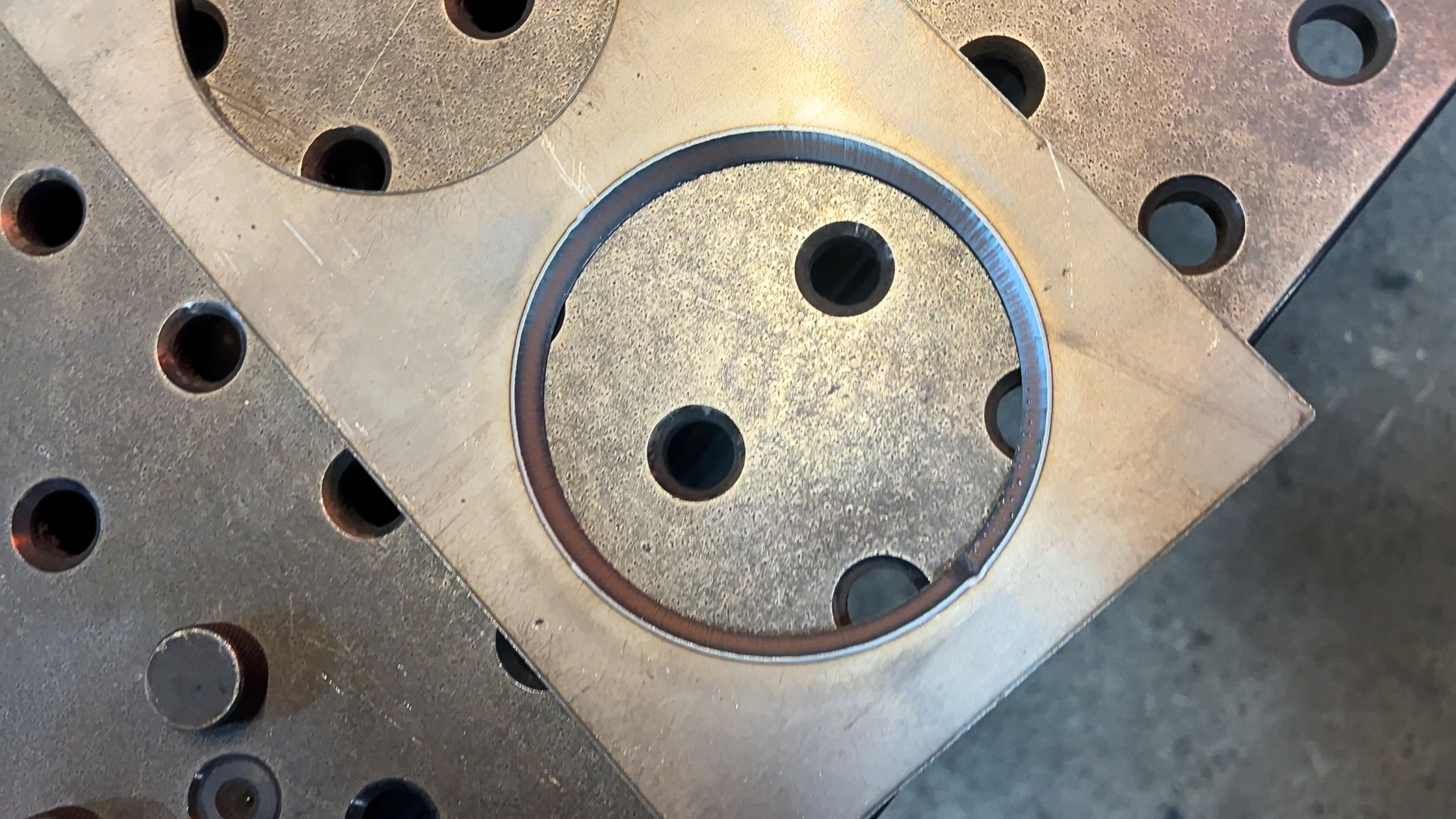
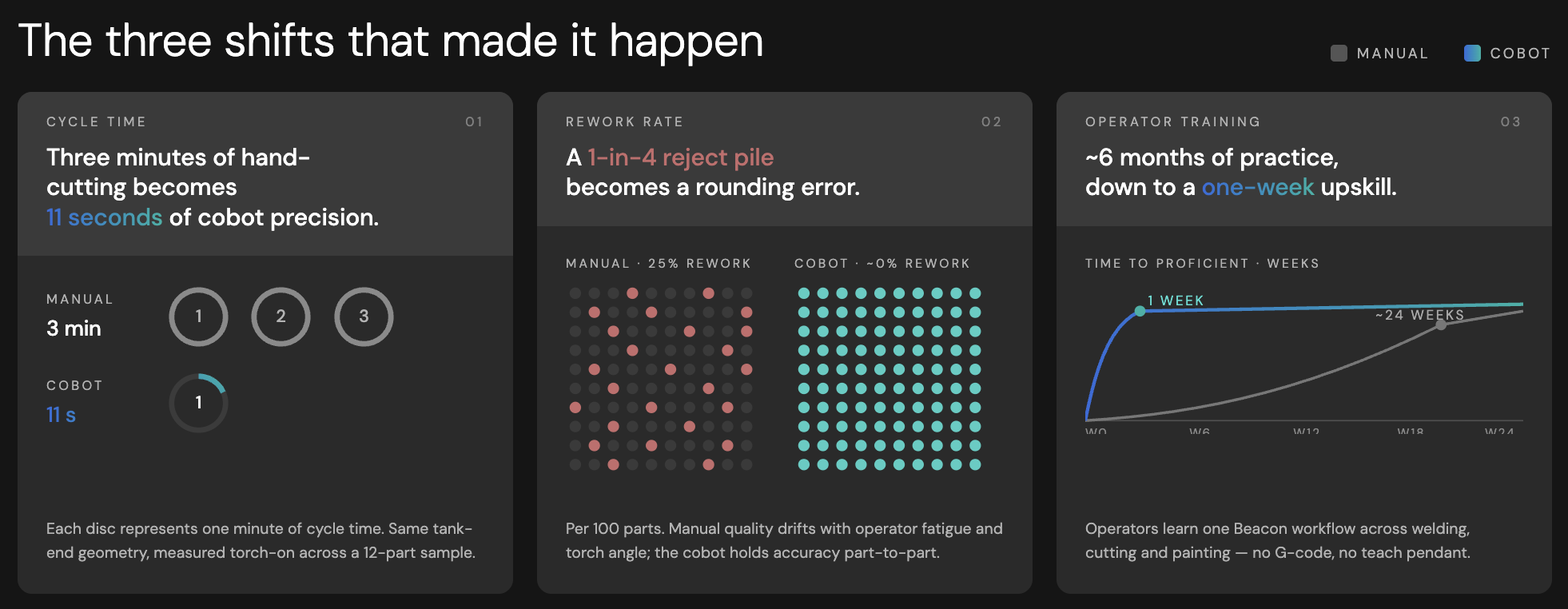
This isn't hypothetical. Tank Technology, an employee-owned manufacturer of custom porcelain-lined water heaters with a team of 50+ makers, hit this wall directly. A quarter of their product line was built-to-order — custom diameters, non-standard fittings, compound curves. Manual plasma cutting produced unpredictable results and roughly 25% rework. Traditional CNC tables couldn't handle the custom geometries. They needed a cutting solution that could scale with a high-mix production environment. What happened next is a useful case study in how this actually plays out.
Manual vs. automated plasma cutting: what actually changes
This is worth being precise about, because most of the plasma content on the internet is written with the handheld operator in mind.
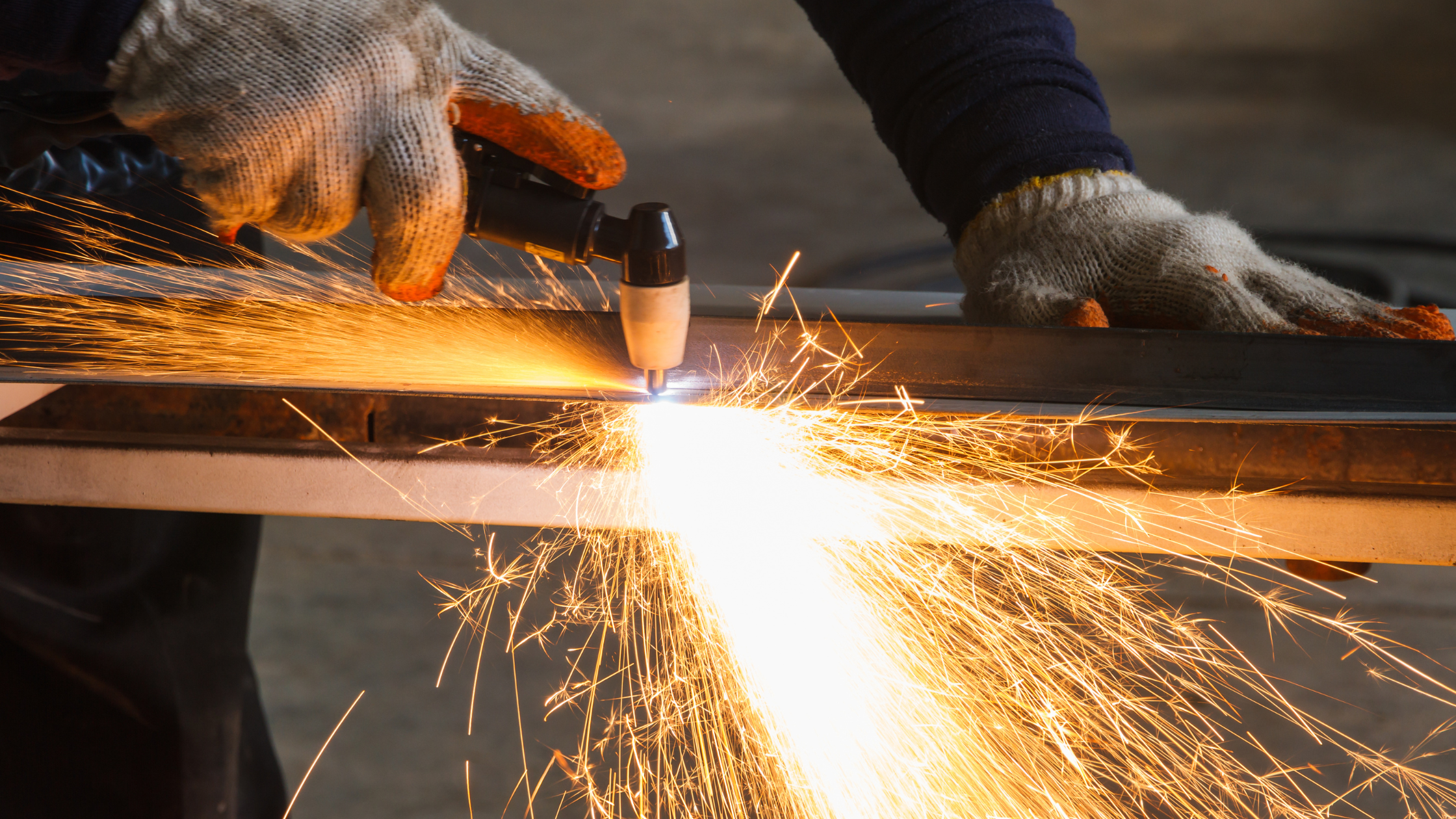
Manual plasma cutting is an operator holding a torch. The power supply — a Hypertherm Powermax, for example — does the heavy lifting electrically. But the result on the part depends entirely on the human: their torch angle, their travel speed, their pierce technique, how steady their hand is at hour seven of a shift. Hypertherm itself is direct about this. Consistent torch angle, ideal travel speed, proper pierce technique, and correct consumable selection are all operator-controlled variables that directly affect cut quality, dross, and consumable wear.
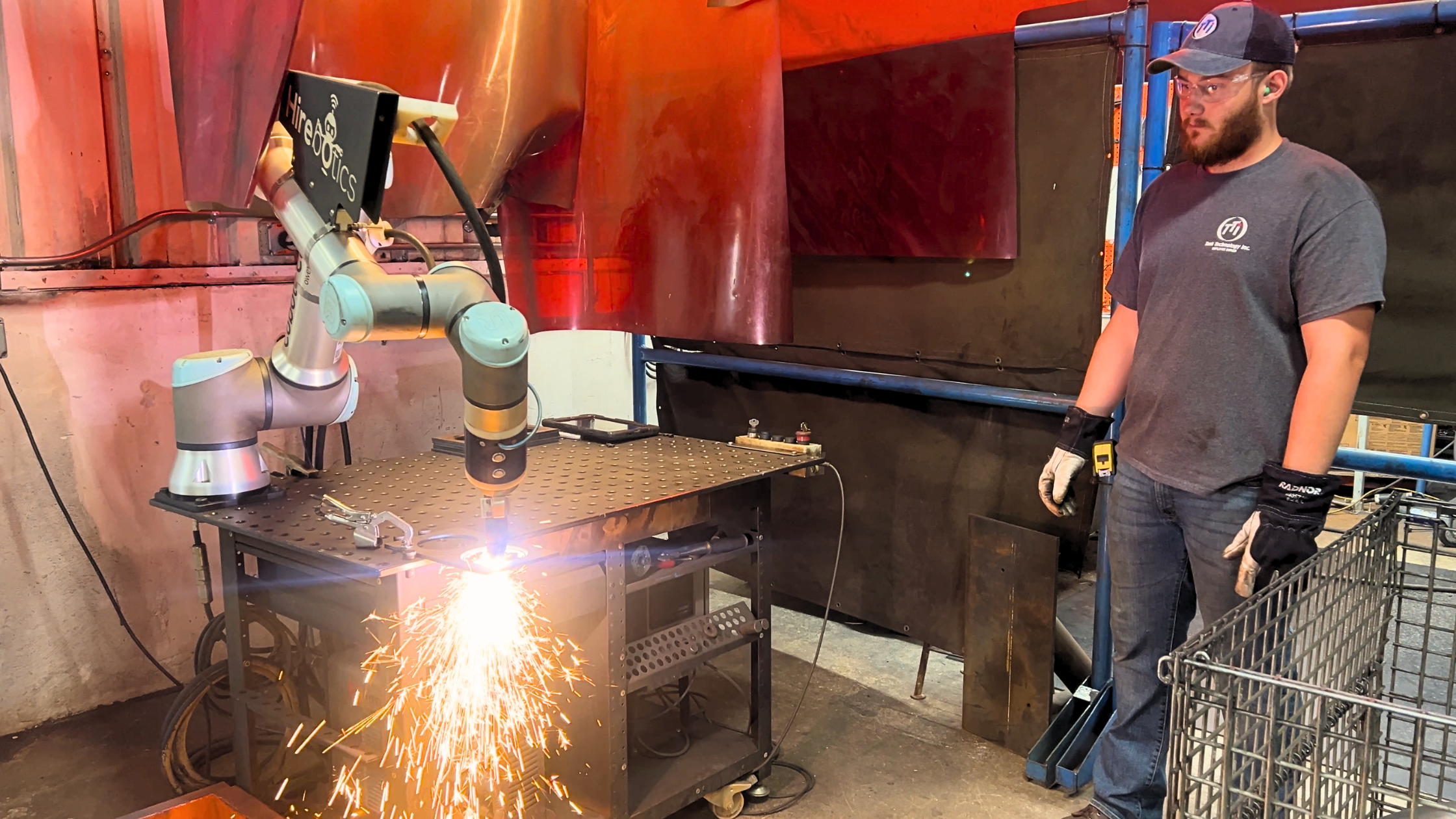
Automated plasma cutting uses the same power supply. A Hirebotics plasma cutting cobot runs the Hypertherm Powermax85 SYNC® as standard, with the Powermax65 SYNC®, Powermax105 SYNC®, or Powermax125® available as upgrades. The plasma side of the system is identical to what a top-tier manual shop would buy. What changes is the torch guidance.
In a cobot cell, a robot arm holds the torch. Beacon programs the path. Travel speed is set in software. Torch angle is mechanically consistent. Pierce height, pierce delay, and arc voltage are controlled by the system, not the operator. The cut you get at the start of a shift is the cut you get at hour four of a lights-out run.
Same plasma technology. Different source of control. That single shift is what unlocks scale.
Tank Technology, by the numbers
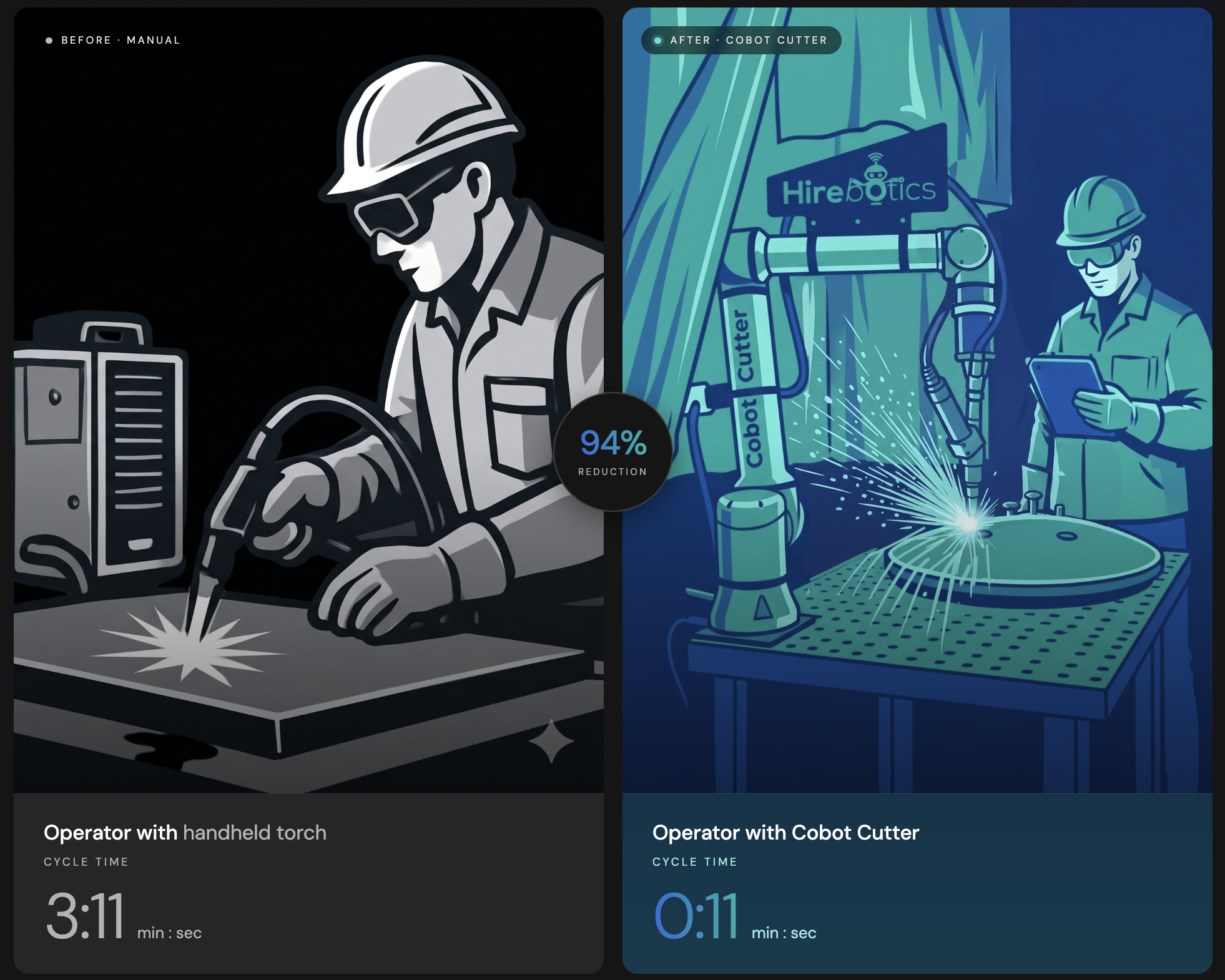
Cycle time per cut: 3 minutes → 11 seconds.
A 94% reduction on the same parts, using a Beacon Cobot Cutter instead of hand-cutting.
Rework: 25% → nearly zero.
Consistent geometry, first-pass accuracy, parts that fit when they hit the next station.
Time to first production cut: hours, not months.
The system was up and running the same day it was installed.
Time for operators to program their own parts: one week.
No robotics background required.
New product capabilities unlocked.
Parts they previously considered impossible to plasma cut — including beveled heads and bases with compound curves — are now in production.
As Eric Pamenter, Tank Technology's ASME production lead, put it: "With the Cobot Cutter, we're seeing perfectly sized holes in perfect locations – every time."
How automation changes the TCO math
Hypertherm publishes six factors that drive plasma cutter total cost of ownership. Three of them shift meaningfully when you automate:
Cutting productivity. Manual plasma productivity is capped by operator duty cycle — how much of a shift the torch is actually on. Between setup, material flipping, fit-up checks, breaks, and fatigue, the torch-on percentage is far lower than most managers realize. An automated cell runs at a much higher torch-on percentage because the cobot doesn't need breaks, and part loading can be batched or staged.
Operating costs per foot. Hypertherm's own cost-per-foot formula is driven by consumable life, duty cycle, and cut speed. Consumables wear faster when parameters are inconsistent — wrong height, wrong speed, wrong pierce. A cobot hits the same parameters every cycle. Same cartridge, more cuts per cartridge, lower cost per foot.
Operator training. Hypertherm makes the point clearly: new or untrained plasma operators create hidden cost in material waste, consumable waste, rework, and downtime. Automation doesn't eliminate the operator — it changes what the operator does. Instead of training someone to cut consistently for 2,000 hours, you train them to set up and run a cell. The learning curve is shorter, and the skill is easier to hire for.
None of this requires a different plasma cutter. The Powermax SYNC line is explicitly designed to run in both handheld and mechanized configurations. The cartridge, the arc, the cut — that's all Hypertherm doing what Hypertherm does. Automation gets more out of it.
Better cuts lead to better welds
Here's the part that often gets missed when plasma is evaluated in isolation.
In a hand-cut shop, inconsistency compounds downstream. A part with variable bevel, inconsistent dross, or a crooked profile has to be ground, reworked, or shimmed before it hits the welding fixture. Every minute your welders spend fighting a bad cut is a minute they're not welding. Multiply that across a program and you're losing real hours a week to a problem that started upstream.
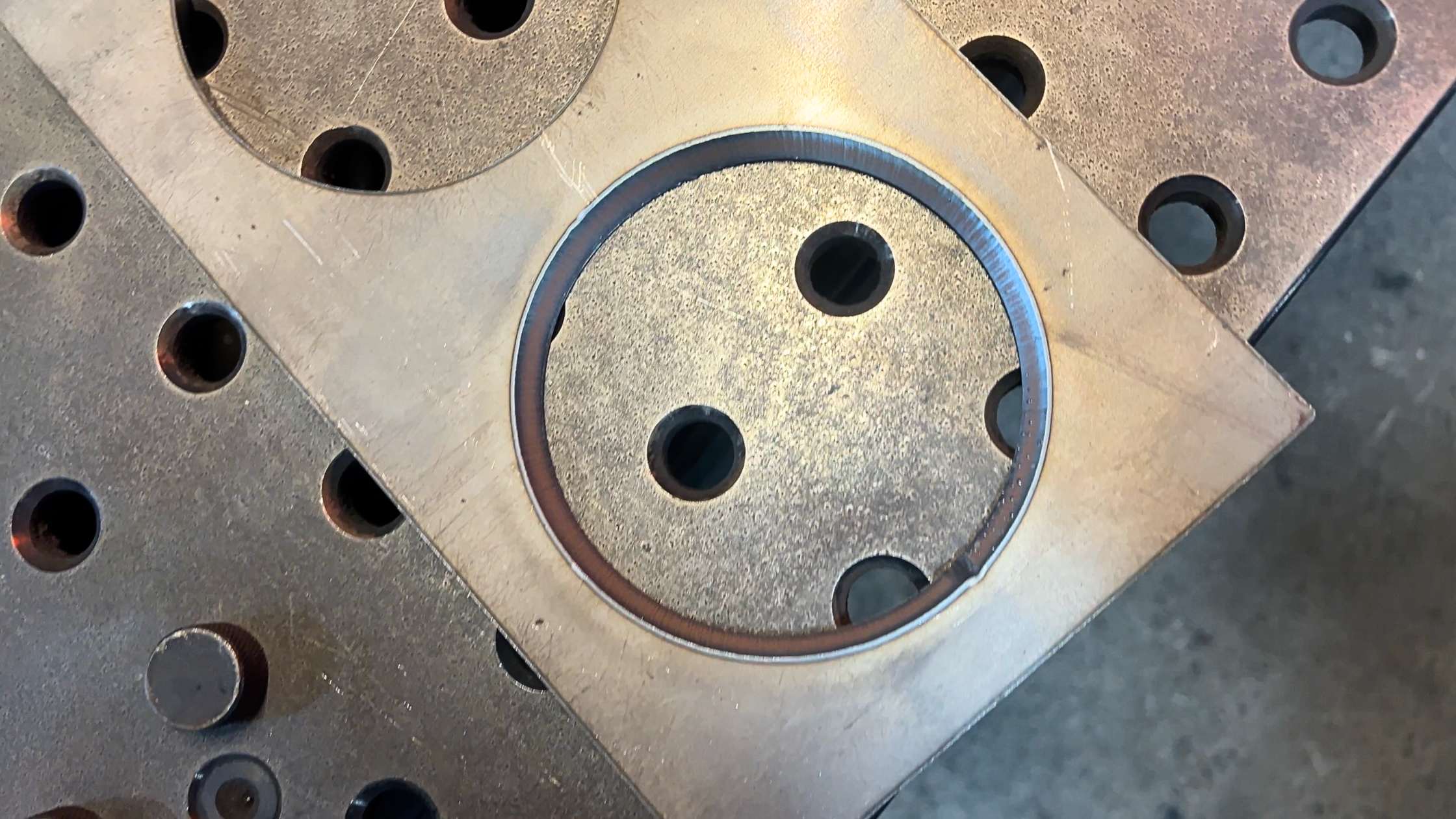
When plasma is automated, the part that arrives at the weld cell is consistent. Fit-up gets faster. Rework drops. And — this is the step a lot of shops don't see until they're already there — consistent cut parts are what make welding automation viable. You can't reliably automate welding on parts that aren't reliably cut. Plasma cutting cobots are, for a lot of shops, the gateway to broader fabrication automation.
Tank Technology is a clean example of how that sequence unfolds. The cobot cutter solved their cutting problem. The consistency of the cut parts made it realistic to add cobots to the weld side. And then the next ceiling appeared — not a technical one, but a certification one. Tank Technology holds ASME H, HLW, and U certifications across their pressure vessel product line, which means code compliance isn't optional in their business. And when they decided to put more of that code-compliant work on cobots, the industry hadn't yet worked out what certification looked like for welding done on a cobot rather than by a human welder.
They worked through it. Here's Eric Pamenter on what that unlocked:
"If there was something I could say about getting our cobots certified, it would be that we knew that was the only thing holding us back from expanding what we could put onto them. We knew that the cobots could physically do it… With the few [ASME code components] we're currently welding, it has allowed us to consistently build an impressive amount more without beating our people into the dirt. In short, the sky appears to be the limit after we certified our cobots."
That's the scaling story in one quote. A cobot can do the work. The ceiling is somewhere else — a workflow, a certification, a proof point — and every time a shop breaks through one of those ceilings, the output steps up without the headcount stepping up with it. Plasma cutting is usually where that first ceiling falls.
The scaling path most shops actually take
Full-line automation isn't the first step. For a fabrication manager evaluating plasma automation, the practical path looks like this:
- Identify the highest-volume, most-repetitive parts. The 20% of SKUs that drive 80% of your cutting hours is where a cobot pays back fastest.
- Start with one cell. One cobot, one Powermax85 SYNC, one operator splitting time between loading that cell and running a manual station.
- Measure for 90 days. Cuts per shift, consumable life per cartridge, rework rate, operator hours redirected, parts delivered on time.
- Expand from evidence, not ambition. A second cell, a second shift on the first cell, or a lights-out configuration — depending on what the numbers actually tell you.
This is how capacity gets added without hiring four new plasma cutters you can't find.
Only with Beacon
A cobot arm is hardware. Beacon is the software layer that turns it into a production tool a fab shop can actually run.
- Cloud-based programming. Operators build and edit cut paths from a smartphone-based app, not a teach pendant. Programs sync across cells. No tribal knowledge trapped in one machine.
- AI-driven recommendations. Beacon suggests parameters based on the job in front of the operator, so setups start from a good baseline instead of from scratch.
- 24/7 online support. When something goes sideways at 11 p.m. before a Monday delivery, a real person on the Hirebotics team is reachable through the app. That's a real line on your uptime calculation.
The underlying philosophy: automation should include people, not replace them. Your operators already know your shop, your parts, and your customers. A Beacon cell meets them where they are — integrating into your shop in hours, not months, and running production from day one. No code. No specialists. No extended downtime.
The decision
Plasma automation isn't right for every shop. If your mix is 80% one-off custom prototypes, a cobot won't pay back quickly. If your volumes are small enough that a single operator with a manual Powermax covers the work with room to spare, you don't have a capacity problem to solve yet.
But if any of this sounds familiar —
- "We turned down work last quarter because we couldn't cut fast enough."
- "Our cut quality varies depending on who's running the torch that day."
- "I've had three plasma cutters quit in the last 18 months."
- "Our margins on cut parts are getting thinner every year."
— then the question isn't whether to automate plasma. It's which parts to automate first, and how fast the math says you can expand from there. Tank Technology started with one cobot cutter. They're now building ASME-certified components on cobots and adding parts to their plasma automation that they didn't think were possible when they started. That's the kind of runway this opens up.
That's the conversation worth having.
Want the full Tank Technology story? Read the case study. Or if you want to see what a Beacon-powered plasma cutting cell looks like on your specific part mix, talk to Hirebotics about a walk-through built around your production environment.